

Book Review- Braiding Sweetgrass
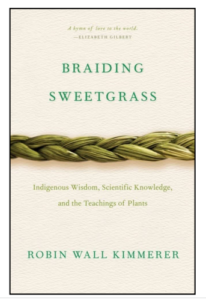 Review by Peggy Hansen
In the preface, Robin Wall Kimmerer writes: “I could hand you a braid of sweetgrass, as thick and shining as the plait that hung down my grandmother’s back. But it is not mine to give, nor yours to take. Wiingaashk belongs to herself. So I offer, in its place, a braid of stories meant to heal our relationship with
the world. This braid is woven from three strands: Indigenous ways of knowing, scientific knowledge, and the story of an Anishinabekwe scientist trying to bring them together in service to what matters most.”
In this beautifully written book, Kimmerer moves back and forth between stories of relationships with her family and her students, very detailed and scholarly descriptions of the plants she loves and their (and our) endangered environment, and the beloved traditions and wisdom of her elders. She describes the ceremonial giveaway, the minidewak, one of her peoples’ oldest teachings.” Generosity is simultaneously a moral and a material imperative, especially among people who live close to the land and know its waves of plenty and scarcity. Where the well-being of one is linked to the well-being of all. Wealth among traditional people is measured by having enough to give away…. In a culture of gratitude, everyone knows that gifts will follow the circle of reciprocity and flow back to you again. This time you give and next time you receive. Both the honor of giving and humility of receiving are necessary halves of the equation.”
She introduces us to the Thanksgiving Address, which embodies the Onondaga relationship with the world. ”Each part of Creation is thanked in turn for fulfilling its Creator-given duty to the others. It reminds you every day that you have enough,” she writes, drawing on the words of Freida Jacques, a teacher at the Onondaga Nation School. “Gratitude,” says Kimmerer, “doesn’t send you out shopping to find satisfaction, it comes as a gift rather than a commodity, subverting the foundation of the whole economy. That’s good medicine for land and people alike.” The recognition of loss is also a theme of her book, as she recounts the taking of children from their tribe and families, isolating them in boarding schools and forbidding them to speak their native language. She mourns the ecological destruction that has changed her beloved Onondaga Lake into “the most chemically contaminated lake in the United States.” But she says: “Despair is paralysis. It robs us of agency. It blinds us to our own power and the power of the earth. Environmental despair is a poison every bit as destructive as the methylated mercury in the bottom of Onondaga Lake…. Restoration is a powerful antidote to despair. Restoration offers concrete means by which humans can once again enter into positive, creative relationship with the more-than-human world, meeting responsibilities that are simultaneously material and spiritual.”